The Riley Family's MacNeil Scottish Roots
15 Generations Back to 1536, Roderick Og MacNeil (34th Chief of MacNeil Clan)
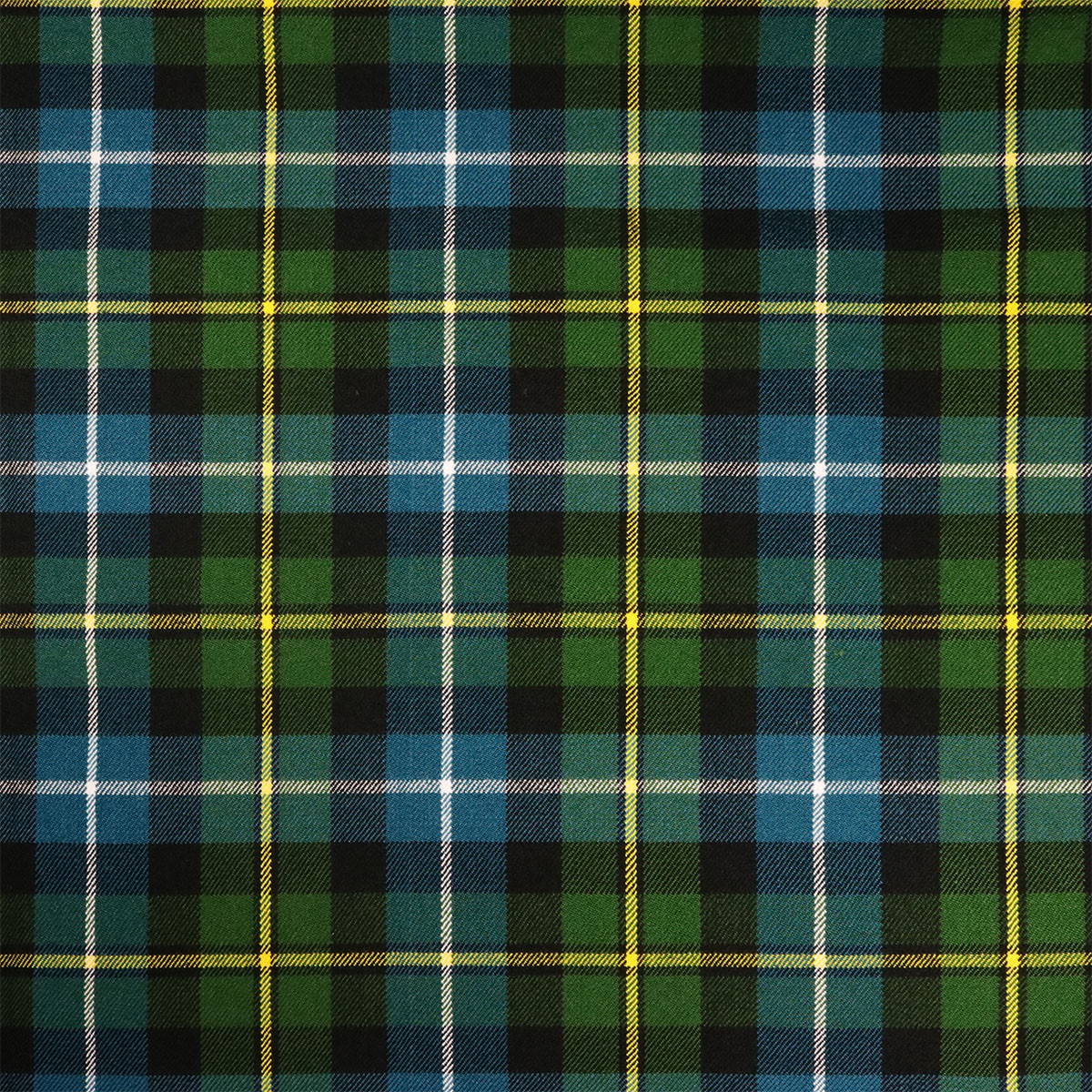
MacNeil Tartan |
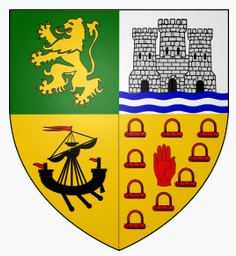 The MacNeil Coat of Arms is divided into quarters: Lion Rampant (mimicking the Royal Standard of the King of Scotland); castle in the water (symbolizing Kisimul Castle); 3-masted ship (representing the seafaring nature of the clan); and the Red Hand of Ulster surrounded by nine shackles representing Niall of the Nine Hostages. |
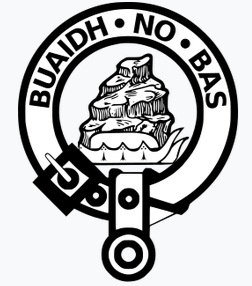 The MacNeil Seal is a crest badge centered on a rock perched on a chapeau, encircled by a buckled belt bearing the Gaelic motto "Buaidh no Bàs," which translates to "Victory or Death." |
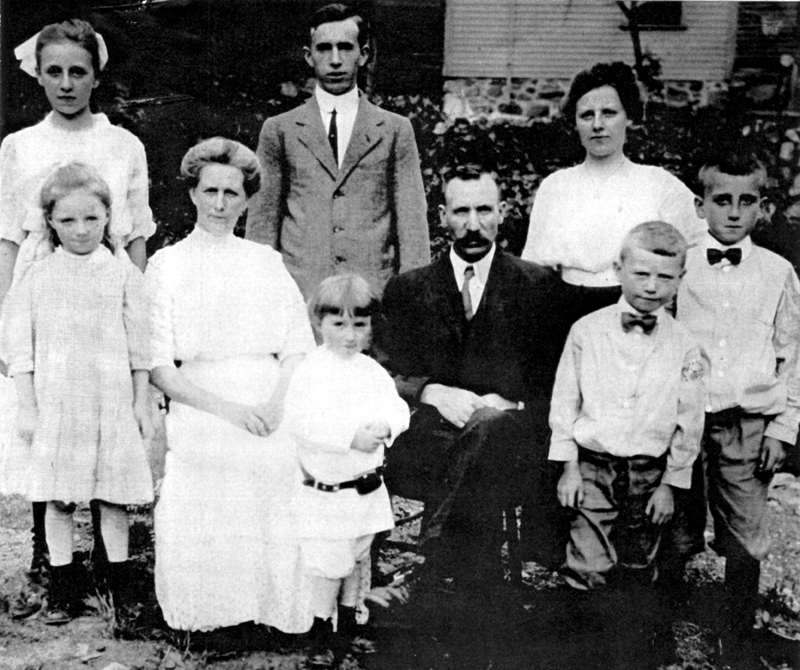 Annie MacNeil and the Cheverie Family |
How are the Rileys related to the MacLean Clan? My 2nd great-grandmother Anastasia "Annie" MacNeil is our first MacNeil ancestor. She was the mother of my great-grandmother Anastasia "Anna" Cheverie, who was the mother of my grandfather William S. Riley, who is the father of my mother Lynne. Find out about the MacNeil Family's journey from Scotland to America >> |
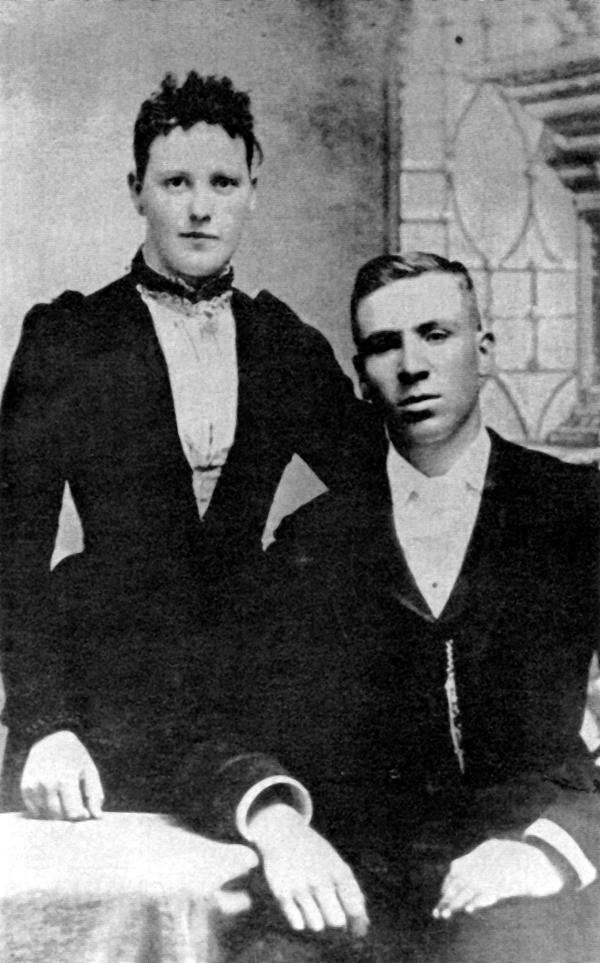 Annie MacNeil and Stephen Cheverie |
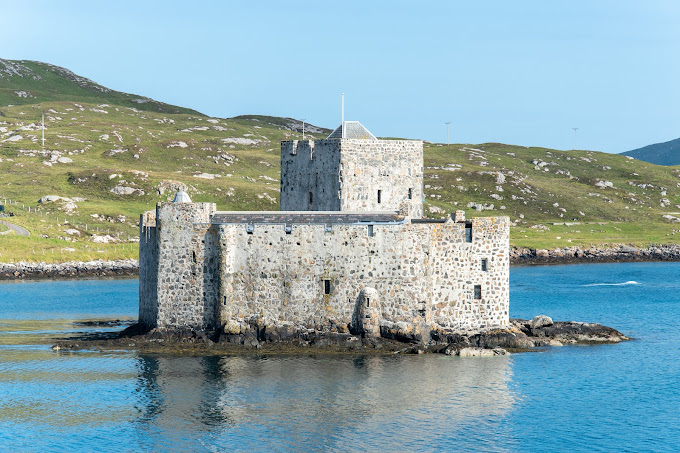 Kisimul Castle in Castlebay, Barra, Scotland. The "Castle in the Sea" is the only significant medieval castle to survive in all of the Western Isles. |
Here we trace back our lineage to 1500s Barra, an island in the Outer Hebrides, Scotland, which is the second southernmost inhabited island there. The Hebrides are the largest archipelago in the United Kingdom. The history of Clan MacNeil splits into two chapters: their legendary rule from Kisimul Castle and their subsequent migration to North America, where they preserved their heritage. It spans centuries of seafaring dominance, Jacobite rebellion, and a diaspora that ultimately shifted the clan's leadership across the Atlantic. |
Descendants of Roderick Og MacNeil (34th Chief of MacNeil Clan)
| 12th great-grandparent |
Roderick Og MacNeil (34th Chief of MacNeil
Clan) b. 1536 Barra, Inverness-shire, Scotland d. 1570 Barra, Inverness-shire, Scotland m. Mary MacLeod, 10th chief and 1st female chief of Clan MacLeod 1545-1602 Mary was a noblewoman and the first female chief of the Clan MacLeod of Harris and Dunvegan on the Isle of Skye. She served as a lady-in-waiting to Mary, Queen of Scots. |
| 11th great-grandparent |
Roderick "The Turbulent" MacNeil (35th Chief of MacNeil Clan) b. 1555 Gigha, Argyll, Scotland d. 3 Oct 1594 Battle of Glenlivet, Scotland m. Marion MacDonald 1554-1609 Roderick "The Turbulent" MacNeil earned his colorful nickname due to his notorious acts of piracy and ongoing clashes with the Scottish Crown. Described as the last of the Vikings, he could retreat to the safety of Kisimul Castle after raiding ships. |
| 10th great-grandparent |
Neill Og MacNeil (36th Chief of McNeil Clan) b. 1580 Tirfergus, Argyll, Scotland d. 1662 Gigha, Argyll, Scotland m. Margaret Josephine MacLean (of Ardtornish) 1590-1651 |
| 9th great-grandparent |
Gillionen MacNeil (37th Chief of MacNeil Clan) b. 1640 Barra, Inverness-shire, Scotland d. 1680 Barra, Inverness-shire, Scotland m. Catherine MacDonald of ClanRanald 1635-1680 |
| 8th great-grandparent |
Roderick Dhu (the Black) MacNeil (38th Chief of MacNeil Clan) b. 1670 Barra, Inverness-shire, Scotland d. 1715 Argyll, Barra, Inverness-shire, Scotland m. Isabella (Isobel) MacLeod (of Bernera) 1670-1750 Roderick Dhu (the Black) led his fellow clansman at Killiecrankie fighting staunchly for the Jacobite cause (the movement to restore the House of Stuart to the British throne). He rallied the Clan MacNeil to the aid of the "Old Pretender" in the Rising of 1715. |
| 7th great-grandparent |
Roderick Ruairidh "Dove of the West" MacNeil (39th Chief of MacNeil Clan) b. 1693 Barra, Inverness-shire, Scotland d. 7 May 1763 Barra, Inverness-shire, Scotland m. Mairi MacKinnon 1700-1763 Roderick's notably peaceful moniker "Dove of the West" came from his generally mild and diplomatic nature. Roderick led his clan during the tumultuous Jacobite era. In 1746, he was arrested and taken to London. For his Jacobite sympathies, Roderick was consigned to a prison ship and it was not until 1747 that his discharge was ordered and he was free to return home. Luckily for Roderick, his estates were not forfeited. |
| 6th great-grandparent |
Jonathon Eoin MacNeil b. 1762 Barra, Inverness-shire, Scotland d. 14 Feb 1825 Barra, East Lothian, Inverness-shire, Scotland m. Christy Gillis 1762-1853 |
| 5th great-grandparent |
Donald MacNeil b. Abt. 1783 Barra, Inverness-shire, Scotland d. 1871 Cape Breton, Nova Scotia, Canada m. Annie Campbell 1786-1873 |
| 4th great-grandparent |
Hector Eachann "The Mason" MacNeil b. 29 Nov 1814 Barra, Inverness-shire, Scotland d. 1871 Cape Breton Island, Nova Scotia, Canada m. Mary Annie MacKinnon b. 1818 |
| 3rd great-grandparent |
James "Jim the Mason" MacNeil b. 1844 Big Bank, Boularderie, Victoria, Nova Scotia, Canada d. 6 Feb 1911 Sydney Mines, Cape Breton, Nova Scotia, Canada m. Anastasia MacIntyre (or McIntire) 1845-1933 |
| 2nd great-grandparent |
Anastasia "Annie" McNeil b. 16 Aug 1872 Howley's Ferry, Boularderie Island, Cape Breton, Nova Scotia, Canada d. 9 May 1938 Lynn, Essex, MA m. Stephen Cheverie Jr. 1873-1917 |
| 1st great-grandparent |
Anastasia (Anna) Elizabeth Cheverie b. 13 Feb 1896 Beverly, MA d. 22 Aug 1933 Nashua, NH m. William James Riley 1888-1950 |
| Grandfather: |
William Stephen Riley b. 19 Jul 1921 Beverly, MA d. 2 Sep 2006 San Antonio, TX m. Mildred Ester Kearney 1923-1964 |
| Mother: |
Lynne Marie Riley b. 1946 m. Peter Robert Nelson 1944 |
| Myself and my Riley cousins |
The Deep Roots of the MacNeils of Barra, Scotland
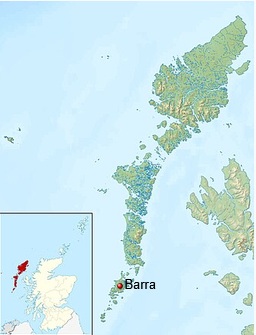
On the inset, the red is the Outer Hebrides off the west coast of Scotland. In the large map, the Isle of Barra is the small island to the south.
The Sea Kings of Barra: The MacNeils trace their lineage back to Niall of the Nine Hostages, an ancient High King of Ireland. By 1049, the first chief established the clan on the Isle of Barra in the Outer Hebrides of Scotland.
The Hebridean Pirates: For centuries, the MacNeils operated as fierce seafarers and galley raiders from their stronghold, Kisimul Castle. Chiefs like Ruari the Turbulent regularly raided English shipping vessels during the reign of Queen Elizabeth I, earning a reputation as lawless "Viking" lords.
The Jacobite Downfall: The clan staunchly supported the Stuart monarchy. Following the failed Jacobite uprisings of 1715 and 1745, the clan's traditional way of life faced heavy suppression from the British Crown.
The Highland Clearances and North American Diaspora: The 18th and 19th centuries brought devastating economic hardships. This triggered a massive wave of emigration from Barra to North America. Facing poverty, the 21st Chief, General Roderick MacNeil, was forced to sell the entire island of Barra in 1838.
Forced Evictions: The new landlord, Gordon of Cluny, initiated brutal Highland Clearances, forcibly evicting tenant crofters to clear the land for profitable sheep farming. In common with many of the new Anglo-Scottish landlords, most of the islanders were evicted in 1851. These were "some of the most cruel and shameful cases of inhumanity ever seen on the West Coast" with many of the displaced islanders joining the Scottish diaspora in Australia, New Zealand, the United States, and Canada.
Settling the New World: Thousands of MacNeils fled across the Atlantic. Major pockets of Barra emigrants established deep roots in Cape Breton and Pictou, Nova Scotia, Canada, as well as parts of North Carolina and the American Midwest.
The American Chief and Kisimul's Rebirth: Because the direct Scottish line died out, the chiefship of the clan legally passed to a branch of the line that had emigrated to the United States. In 1937, an American architect named Robert Lister MacNeil (the 45th Chief) traveled back to Scotland, repurchased the ruined ancestral estates, and painstakingly restored Kisimul Castle to its former glory. In 2000, his son leased the castle to Historic Environment Scotland for a symbolic annual rent of £1 and a bottle of Scotch whisky, ensuring it remains preserved for visitors today.
The MacNeil Family's Journey from Scotland to America
In the 1850s, most inhabitants of Barra, Scotland were evicted by new landlords after a period of economic hardships throughout the 18th and 19th centuries. Many of the displaced islanders joined the Scottish diaspora to Canada and America.
The Stephen Cheverie Family. Seated are Annie McNeil and Stephen Cheverie. Included are their seven children James, Anastasia, my great-grandmother (standing in back right), Laura, Bernard, Walter, Helen, and Louis.
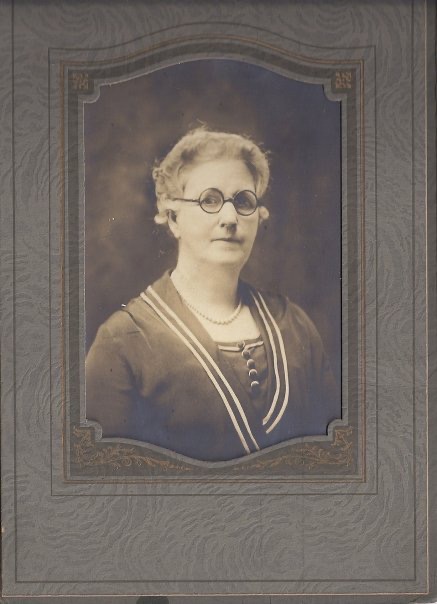
Annie MacNeil Cheverie later in life.
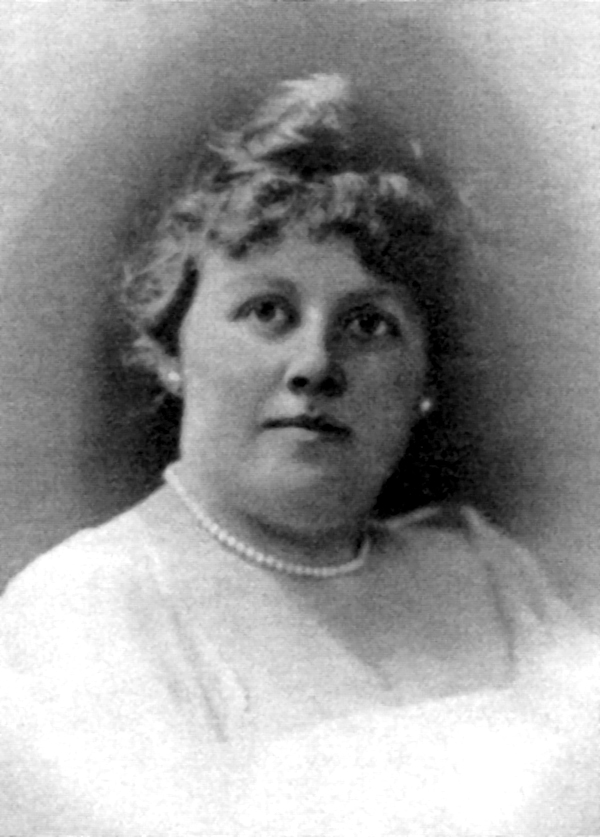
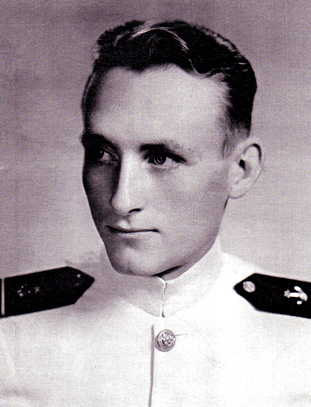
Anastasia (Anna) Elizabeth Riley, née Cheverie, and her son, William Stephen Riley.
Our MacNeil ancestors immigrated due to these reasons. It began with my 4th great-grandfather, Hector Eachann "The Mason" MacNeil, born in 1814 in Barra. We don't know exactly when he immigrated, but we know he was living in Barra in 1841 from the Scottish Census. Then, his son James "Jim the Mason" McNeil was then born in 1844 on Boularderie Island on Cape Breton Island, Nova Scotia, Canada. So we can conclude he must have immigrated to Nova Scotia between 1841 and 1844. Many MacNeil immigrants moved to Cape Breton, a rugged island of 3,981 square miles on the Atlantic coast of Nova Scotia.
Then, my 2nd great-grandmother Anastasia "Annie" McNeil was born in 1872, also on Boularderie Island, Cape Breton. However, by the time she died in 1938, she was was living in Lynn, Massachussetts. Her husband, Stephen Cheverie Jr., was also born on Boularderie Island, so I conclude that they must have met there, and then immigrated to Massachussetts together. They were married in Beverly, Massachusetts in 1893, so we can assume they were in America by 1893. They, like many other Scottish immigrants from Nova Scotia, made their way to America in search of work.
In the 1900 US Census, Stephen Cheverie was listed as working as a house painter. In the 1910 census, the family lived in Essex, Mass., on Pond Street. They had seven children: James, 16; Anastasia "Anna" (my great-grandmother), 14; Laura, 11; Bernard, 9; Walter, 6; Helen, 4; and Louis, 2.
In the 1920 Census, Anatasia "Annie" was 49 and a widow, as Stephen had died in 1917. She lived on Westberry Street in Essex, with six of her children: James, 25; Laura, 21; Bernard, 17; Walter, 16; Helen, 14; and Louis, 12. My great-grandmother Anastasia "Anna" Cheverie married William James Riley on Nov. 15 1914, in Beverly, Mass., so she was not in the household anymore. During the 1920 census, they lived on Grant Street in Essex, Mass.
Anastasia "Anna" and William J. Riley had their son, my grandfather William Stephen Riley, in 1921 in Beverly, Mass. William married Mildred Ester Kearney in 1943, and then they had six children, William James, Lee, Lynne, Mark, Laura and Anna.
Selected sources:
Isle of Barra - Kisimul Castle
Historic Environment Scotland - Kisimul Castle
Great Scottish Clans - MacNeil
Printer-friendly version of this page (PDF)